On the afternoon of April 12, 1945, with Soviet artillery already within earshot of the capital, Albert Speer arranged one final concert by the Berlin Philharmonic.
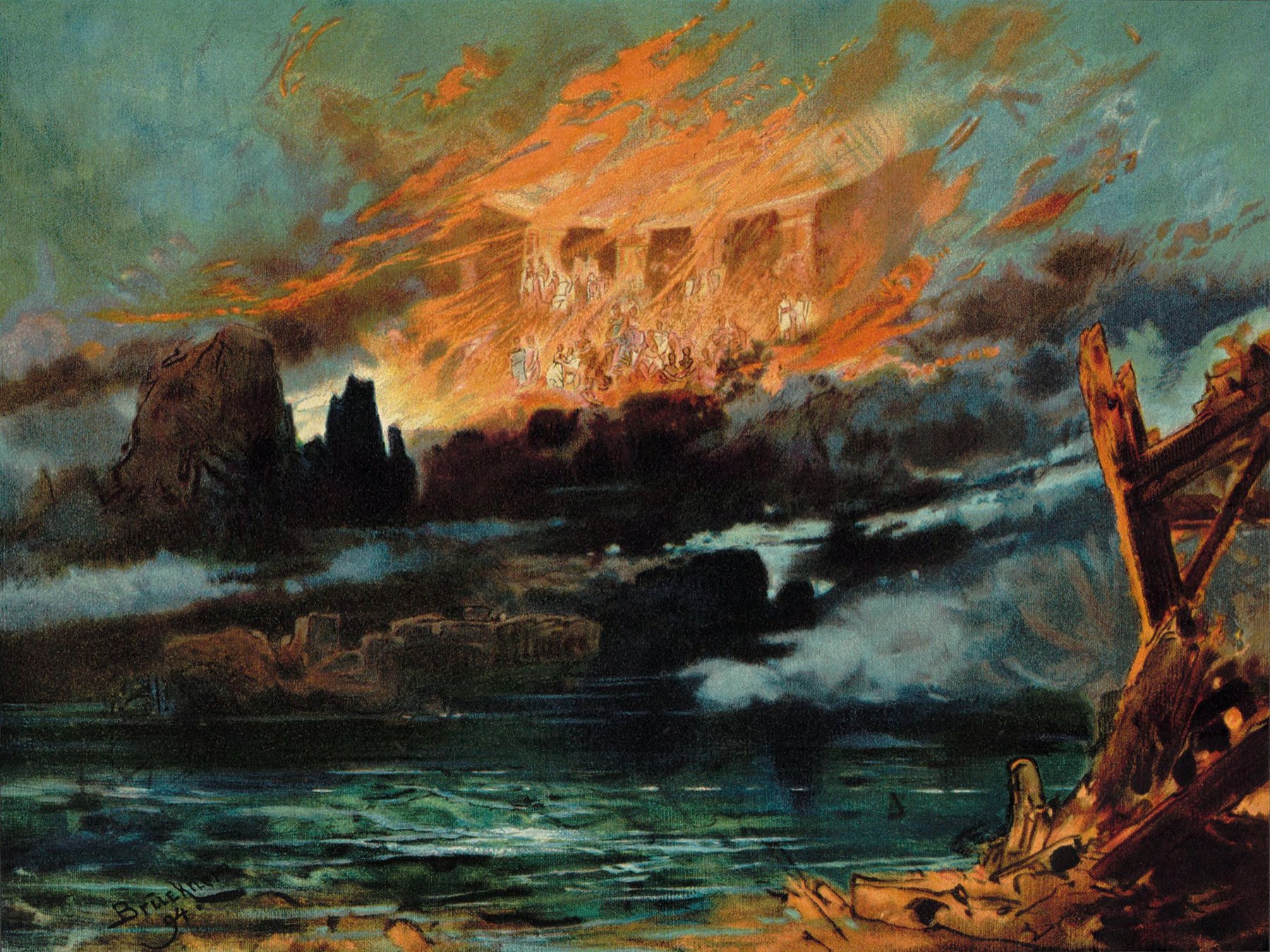
With the Red Army massed east of the city and the threat of Allied bombers above, a packed audience sat tensely in the unheated Beethovensaal. Speer had chosen to play the immolation scene from Richard Wagner’s Götterdämmerung – The Twilight of the Gods.
At the conclusion of Wagner’s opera, Brünnhilde rides into her murdered Siegfried’s pyre. The Rhine overflows. Valhalla catches fire. The gods burn with it.
For now the end of the gods is dawning.
Outside the concert hall, Berlin had already begun to burn.
Eighteen days later, Hitler would shoot himself in the Führerbunker. His body, on his explicit instructions, was carried into the Chancellery garden, doused in petrol, and set alight.
The old world burns so that another may begin.
The Romanticization of the Reich
“Hitler will emerge from the hatred that surrounds him now as one of the most significant figures who ever lived. He had boundless ambition for his country, which rendered him a menace to the peace of the world, but he had a mystery about him in the way that he lived and in the manner of his death… He had in him the stuff of which legends are made.” Diary of a 28-year-old American reporter, Berlin, August 1, 1945
John F. Kennedy’s thoughts on Hitler turned out to be true. As of this writing, eighty-one years have passed since the death of Hitler and the collapse of the Third Reich. Since then, the Western liberal order has landed men on the moon, outlasted Soviet communism through a global nuclear arms race, and watched China rise into a rival superpower, yet Hitler and his Reich remain as culturally relevant as ever, if not more so. Spend enough time on the internet, and you will most certainly encounter the conspiracies of Hitler’s “true” fate and fantasies of the technological utopia that supposedly followed a Totaler Sieg.
The character of this fascination has evolved. In the immediate aftermath of the war, the Reich was a catastrophe that demanded explanation. But for later generations, increasingly removed from its violence, it has become more abstract and mythologized. The internet has romanticized the Reich into an aesthetic, a counterfactual civilization, and even an unrealized future.
It is tempting to dismiss this romanticization as evidence for a nascent neo-Nazi movement incubated in the cesspools of the Internet. In some accounts, that explanation is indeed correct. But it cannot account for the trend as a broader cultural phenomenon, particularly among those with no neo-Nazi sympathies. Doing so only avoids the more troubling question. Why has the Reich transformed into such a compelling object of fantasy within modern Western liberal democracies?
The romanticization of the Reich tells us less about Nazism itself and more about the state of the societies in which the romanticization occurs. These fantasies rarely center on racial doctrine and purification. Instead, they concentrate almost predominantly on qualities perceived as absent from contemporary political life: monumental ambition, technological momentum, and decisive collective purpose. Whether these qualities constitute an accurate account of Nazi Germany is completely beside the point. What matters is the reason why these qualities are the objects of such fascination.
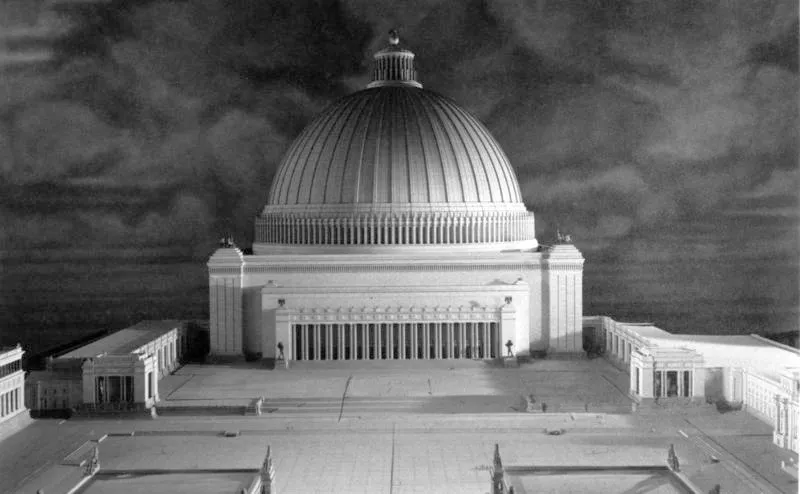
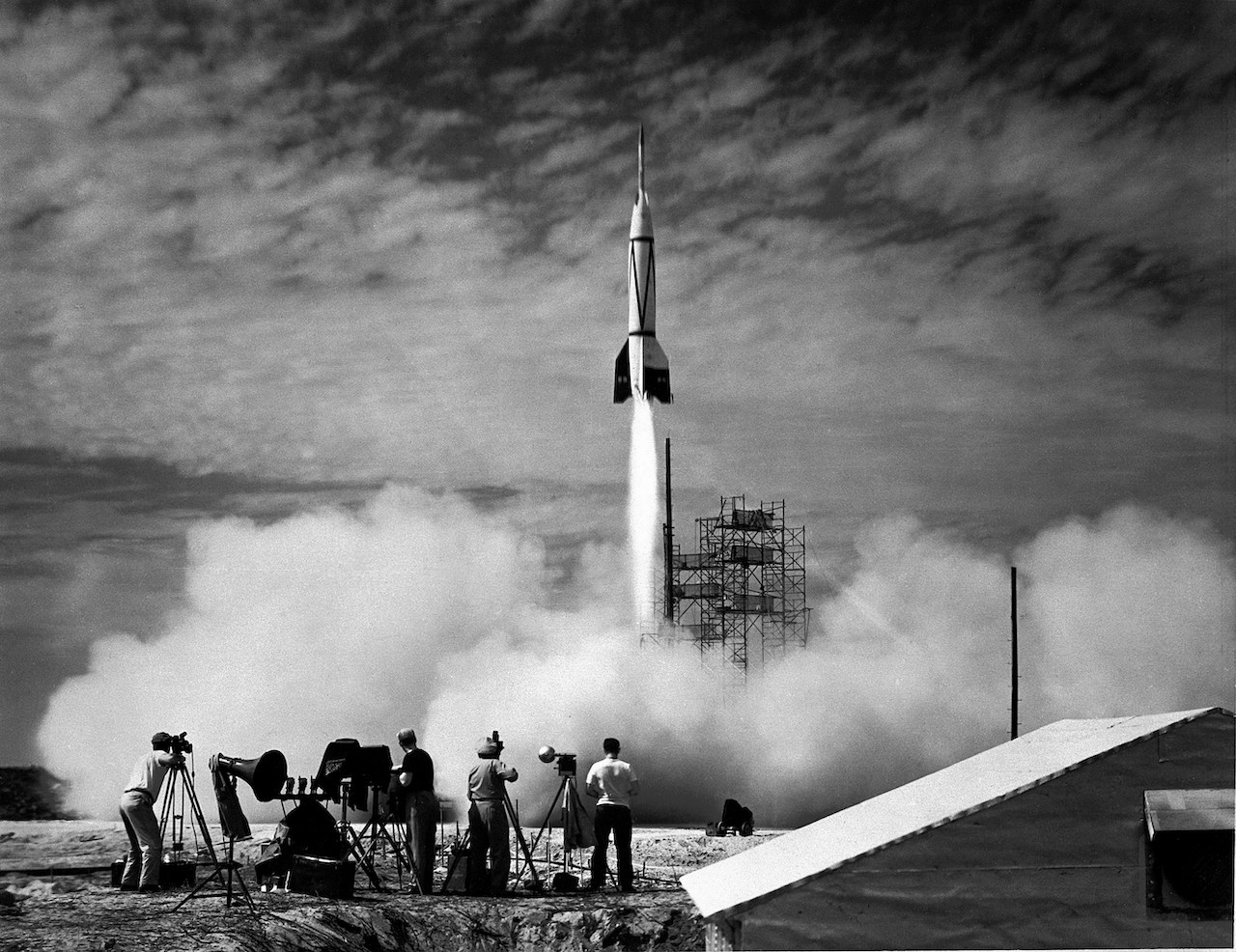
Nothing encapsulates this attraction better than Albert Speer’s plans to transform Berlin into Germania. At Germania’s center would have stood the Volkshalle, a domed assembly hall designed to hold 150,000 people. Its size was so massive, the architects noted that the breath and perspiration of the assembled crowd would have formed clouds beneath the dome and fallen back as rain. Set beside the discovery of nuclear fission, the development of jet propulsion, and the V-2 rocket, such plans make it easy to imagine a civilization accelerating toward the future. The thousand-year Reich made bold plans for the next millennia. In this view, the Nazis were definite optimists.
Set against this, the environment of modern liberal democracies appears strangely stagnant. Our modern societies, by contrast, scarcely make plans at all, let alone civilization-defining ones. Eighty years of peace in Europe have produced cities defined by regulation, preservation, and incremental development. Where Speer’s Berlin was conceived as a single overwhelming statement of political power and cultural consolidation, present-day Berlin is conceived by planning committees, political compromise, and environmental activists championing the lack of air conditioning.
Even the most ambitious modern projects of the liberal West rarely approach the totalizing scale once imagined by the Reich. California’s High Speed Rail proposes to connect the state’s great northern and southern cities; the Breitspurbahn aimed to connect the entire continent with colossal trains that included a 196-seat movie theater, a barbershop, a sauna, and a swimming pool. In the eighteen years after Californian voters approved the project, and after $15 billion in expenditure, not a single foot of operational track has yet been laid. The Breitspurbahn, of course, never came close to realization either. But it died amidst total war, steel scarcity, and the eventual collapse of the regime that conceived it. California has no such excuse. It is the richest state in the US and ranks the 4th largest in the world, has never seen an invasion, and sits atop perhaps the greatest concentration of engineering talent in human history.
And of course, Germania and the Volkshalle also were never built. But myths draw their power not from reality, but from the imagination. The fantasy of the Reich persists despite its collapse into ruin and the complete failure of its megaprojects because the fantasy is exactly what liberal democracies increasingly fail to provide: a vision of the future powerful enough to inspire belief and a sense of collective purpose toward action. Therefore, the modern romanticization of the Reich is a form of extreme nostalgia, not for the true historical reality of everyday Nazi Germany, but for the imagined possibility of a society still capable of acting decisively with an overwhelming collective purpose. The romanticization functions as the darkest possible mirror to the liberal West, showing us the inverted image of what our own civilization has failed to provide.
In these moments of perceived civilizational stagnation, the appetite for scale, unity, and decisiveness grows only greater. We must confront the uncomfortable implications of such a longing. The disturbing question is not why such fantasies persist at all, but what a society might eventually be willing to sacrifice if it ever decides that the absence of greatness has become more intolerable than its cost.
An Anatomy of Postwar Liberalism
René Girard
“Murder is the secret origin of all religious and political institutions, and is remembered and transfigured in the form of myth. The scapegoat, perceived as the primal source of conflict and disorder, had to die for there to be peace. By violence, violence was brought to an end and society was born.” Peter Thiel on René Girard1
For René Girard, the basis of human desire is mimesis: people learn what to want by imitating the desire of others. It is because of this mimetic tendency to desire the same things that conflict and rivalry arise and escalate in a community. Violence and disorder become increasingly reciprocal. At a certain threshold, when such violence becomes existential to the community, an unconscious convergence of blame fixates upon a single figure or scapegoat. Regardless of the scapegoat’s actual guilt or innocence, the peace and collective catharsis following their expulsion or killing are interpreted, in retrospect, as proof that they were the source of the community’s problem.
The rise of National Socialism can be interpreted through this Girardian lens. Hitler displaced the existential failures of the Weimar Republic onto the Jews, who were made, in the Nazi imagination, the single hidden cause of Germany’s economic humiliation, political fragmentation, and cultural degradation. When the forced emigration and legal separation failed to produce the ideal national community the regime had promised, persecution culminated in their systematic extermination through the Endlösung der Judenfrage. Within the regime’s Girardian logic, the Volksgemeinschaft could attain lasting unity and peace only after those it had designated as its corrupting element had been removed entirely.
The same Girardian analysis extends to the founding of the postwar liberal order. Hitler’s death can be understood as the founding expulsion from which the modern West emerged. Liberalism upheld freedom, individual rights, and suspicion of governmental tyranny; the Reich practiced the opposite. Each claimed the authority to determine Europe’s political and cultural destiny, and therefore their shared existence became impossible. In this way, April 30, 1945 can be seen as the symbolic moment at which the modern liberal West itself underwent a historic refounding.
However, Hitler was not a traditional scapegoat whose innocence can be contended with; his guilt was undeniable. The sheer blatancy of his crimes had effectively enabled the Allies to consolidate not only the entire European catastrophe onto himself, but also supplied the Allied members with, ex post, a justification for their own morally ambiguous acts of violence and hypocrisies. Necessary wartime conduct that should not have been undertaken in the name of liberal principles could later be justified into a redemptive narrative in which every transgression is excused and moralized as part of the struggle against absolute evil. His death permitted the Allies to emerge from the chaos with a degree of innocence unavailable to the victors of prior wars.
Thus, the decades that followed produced a genuine era of reconstruction and expansion. Europe had to be rebuilt, along with the newly constituted Bretton Woods system of financial institutions. Vast and alluring technological frontiers opened for exploration, while the success of the Manhattan Project – and the guilt released by the bomb – encouraged a broad trend of de-weaponization. Nuclear weapons gave rise to nuclear reactors; wartime jet propulsion enabled the commercial jet engine; the V-2 led, through von Braun, to the Saturn V. Although much of this future was enabled by technologies developed under the pressures of the war, and in some cases, directly inherited from the defeated Reich, the liberal West also proved capable of a definite form of optimism. On this point, Mazzucato’s argument is not absolute enough.
Yet the West’s capacity for decisive action – especially America’s – had a peculiar structure: to mobilize at scale, it required war. In peacetime, the liberal order remained institutionally dispersed, economically privatized, and broadly suspicious of concentrated power. War supplied the legitimizing force through which state and industry could be coordinated toward more ambitious ends.
Early Nazi Germany began from the opposite condition. Its authoritarian institutions, rearmament programs, and command structure were organized for mass mobilization long before war began. For the Reich, the war was conceived as a Girardian precondition, but was meant to be brief. Blitzkrieg would clear the ground fast, and the future would be paved afterward. The warring Reich required a condition of peace to execute their plans. The peaceful West required war.
God is the Devil
Above all, Hitler’s death would not only establish a temporary peace, but it would supply the postwar West with a negative founder against which its moral identity would be compared. The West would define itself as anti-Hitler, and its purpose would be to guard against the possibility of a fourth Reich. “Never again” became the guiding principle of the newly emerging liberal international order. But the momentum of victory dissipated within a few short decades, and with it also disappeared the West’s sense of a viable future. What remains is the negative foundation.
But in Girard, a dead scapegoat does not remain permanently accursed. Because peace follows, the community eventually attributes the scapegoat as the sole figure to have restored it. For having founded the peace, the scapegoat would be deified. The evil that once was becomes now sacred. Hitler, too, would become not just the negative founder of the postwar West, but the only sacred figure. However, his divinization would be apophatic. He would be worshiped only as the figure who must be eternally abjured.
This presents an apparent paradox. How could a secular liberal order, founded upon the removal of sacred truth from politics, produce a sacred figure of its own? The answer begins with a religious war:
The early modern era of the West—the sixteenth and seventeenth centuries—was characterized by the disintegration of these two older traditions [Athens and Jerusalem] and by ever more desperate attempts to force everything back together into some functioning whole. Where agreement over questions of virtue, the good life, and the true religion was unraveling, the immediate attempt involved forging such an agreement through force. This force escalated in the periods of the Reformation and Counter Reformation, and culminated in the paroxysm of the Thirty Years’ War, which remains perhaps the most deadly period in the history of Europe. By some estimates, in Germany, the locus of the conflict, well over half the population was eradicated. The Straussian Moment, Peter Thiel1
The conflict would end with the Peace of Westphalia, where the sovereigns would choose to agree to disagree. The bloodshed failed to produce any reconciliation among the sovereigns; instead, it exacerbated their differences.
Thomas Hobbes and later John Locke would transform this failure into the defining aspects of liberalism. For Hobbes, the answer to this dilemma was that peace must come before truth. The sovereign’s role would no longer exist to secure salvation, but instead to prevent disagreements collapsing into civil war. Auctoritas, non veritas, facit legem. Where Hobbes buried the truth-question underneath the premise of authority, Locke would relocate it from the jurisdiction of government to the conscience of private individuals. The magistrate’s proper task would be the protection of life, liberty, and property. Questions – of the good life, of religion, and of virtue – are much too dangerous, for disagreements over them carried an endless capacity for violence. Liberalism was born to prevent the bloodshed of the past, and with it the state would remain neutral and no longer decide questions pertaining to the sacred.
Yet no political order is truly neutral. Every regime has its sacred, and every sacred has its taboo. In imperial China, one could not touch the Son of Heaven: even his name was forbidden to write, and treason condemned nine familial generations. In medieval Christendom, one could not repudiate the authority of Church and God: Aquinas argued that heretics should be put to death. Under the French monarchy, one could not attack the majesty of the sovereign: lèse-majesté could be punished with spectacular brutality. A regime reveals what it worships by what it refuses to permit.
In the postwar liberal West, one cannot question the evil of Hitler. Everything else can be profaned: you can mock God, burn the flag, and condemn the founding fathers. But to absolve Hitler, trivialize his crimes, or recast him as innocent is to cross the final moral, and in Germany, legal boundary. Hitler’s evil must be absolute – that much so is sacred. Our liberal society reveals its true god by what it still punishes as blasphemy.
The core feature of liberalism emptied politics of every positive sacred image, leaving behind a void that only its devil could fill. It possesses no common account of what man should become, only the image of what he must never become. The highest moral principle in modern liberal societies is not a vision of goodness – such questions cannot be answered without violence, so one must not answer – but instead the prevention of absolute evil. Hitler is our god, and our God is the devil.
Indeed, “in the manner of his death,” Hitler had prepared himself strangely well for this role. Mussolini’s attempt to escape ended with his capture, execution, and public desecration. A defeated tyrant who is captured, humiliated, and publicly executed is returned to the scale of an ordinary man – no one romanticizes Mussolini. Hitler denied the victors that final desacralization. In his final act, he kills himself beneath the ruins of his empire, and orders his body burned. Whether or not Wagner was in his mind, his death was indeed Wagnerian. Like the gods of Valhalla, he chose immolation over capture, and marked his passage out of history and into myth. For the Allies, there would be no corpse to display and no grave to mark. And unlike the prior conquerors of Europe whose tomb can be visited, Hitler left nothing to see. His absence can only be imagined.
Thus, the romanticization of the Reich is not simply a rebellion against the postwar order, but a hidden aspect of liberalism. Liberalism, having renounced the positive sacred, organizes its moral intensity around a negative absolute: the figure of Hitler and the catastrophe for which he stands. Around this forbidden object gather the old energies of religion: dread, anathema, ritual denunciation, and the punishment of blasphemy. But just like religion, the sacred not only terrifies, but fascinates. What is absolutely forbidden is also made inexhaustibly fascinating. Hitler is the prohibited and sacred figure of the modern West. The resulting fascination and romanticization is not simply a failure of the prohibition; it is the prohibition, just seen from its other side. Mysterium tremendum et fascinans.
A negative god, unlike a positive one, is infinitely more useful. Carl Schmitt held that the political begins with a fundamental distinction between friend and enemy. A community knows itself by knowing whom it stands against. However, liberalism was designed to try to blur this distinction, but it does not work within a society founded upon a negative sacred. A public that can no longer be mobilized toward a common future can still be mobilized against Hitler. So Hitler is found again and again in the modern liberal West.
Saddam Hussein was Hitler. Osama bin Laden was Hitler. Putin is Hitler, invading Ukraine under the pretense that they themselves are run by Nazis. Here, both sides fight against the same enemy. The political left sees Nazis in the Proud Boys and the KKK. The political right sees Nazis in Antifa – who are supposedly anti-Nazi Nazis. Reductio ad Hitlerum is no longer a fallacy but the very fine structure of politics. Godwin’s law is perhaps even more applicable beyond the internet. Any dispute in the liberal West, continued for long enough, terminates in an appeal to its only remaining sacred figure.
As the living memory of the war disappears, with no shared image of the transcendent and no universally compelling vision of the future, it is little wonder that the young begin to look elsewhere. And nothing is more enticing than the forbidden image of the sacred. What remains is a civilization organized around prevention rather than inspiration. When a civilization can no longer say what it loves, it will define itself by what it hates – until some of its sons begin to love the object of its hatred.
Such are the dreams of an age that has forgotten how to dream.