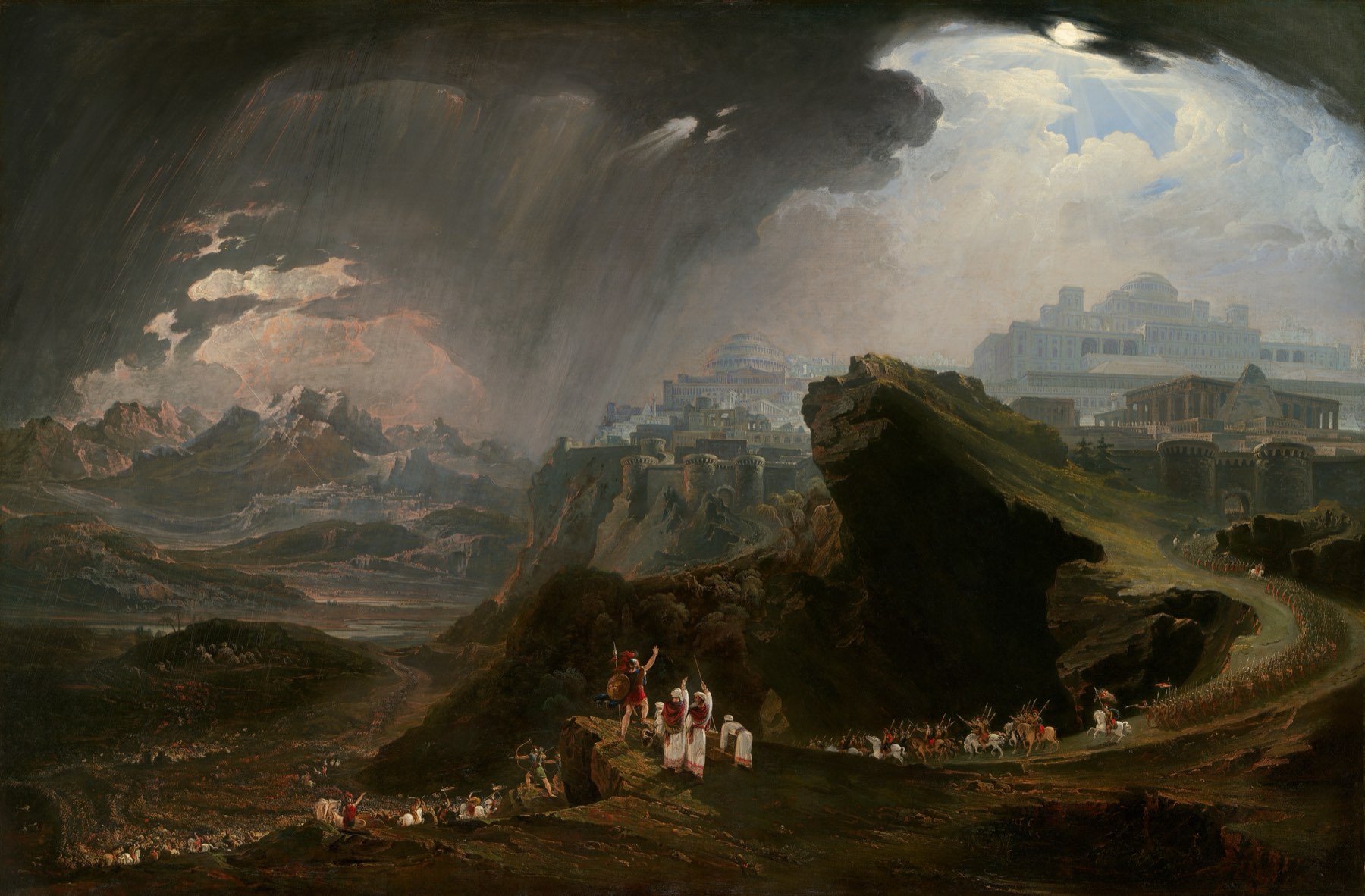
In January of 1946, in the cold expanse of the Mojave Desert east of Los Angeles, two men watched the sun sink below the horizon.
For the previous eleven days, in a candlelit mansion on Pasadena’s Millionaire Row, they had been conducting an experiment. One man traced pentagrams in the air with a consecrated knife and recited invocations in Enochian, the angelic language of God revealed centuries earlier to Elizabeth I’s astrologer. The other man, his scribe, carefully recorded each operation and the strange occurrences that followed.
Their purpose was to summon a goddess named Babalon, the same Babylon of Revelation, the scarlet woman seated upon the Beast, drunk on the blood of saints and condemned as the great corrupter of the Earth. They were to prepare the way for her incarnation in human form.
During their workings, they were disrupted by a massive, sudden windstorm, nine violent knocks in the night, a table lamp thrown to the floor, and the failure of the mansion’s electrical system. When the rituals ended, however, nothing seemed to have happened. But the last several days of their workings were marked by an increasing tension and unease.
Then, on January 18, while the two men were in the Mojave at sunset, the feeling suddenly vanished. One man turned to the other and said with absolute certainty, “It is done.” When they returned to Pasadena, they found a red-haired woman whom they had never met waiting at the house. Her name was Marjorie Cameron.
The scribe who had documented the operation was a 34-year-old Navy veteran and pulp science fiction writer named L. Ron Hubbard. Within a few years, he would found a religion of his own: the church of Scientology.
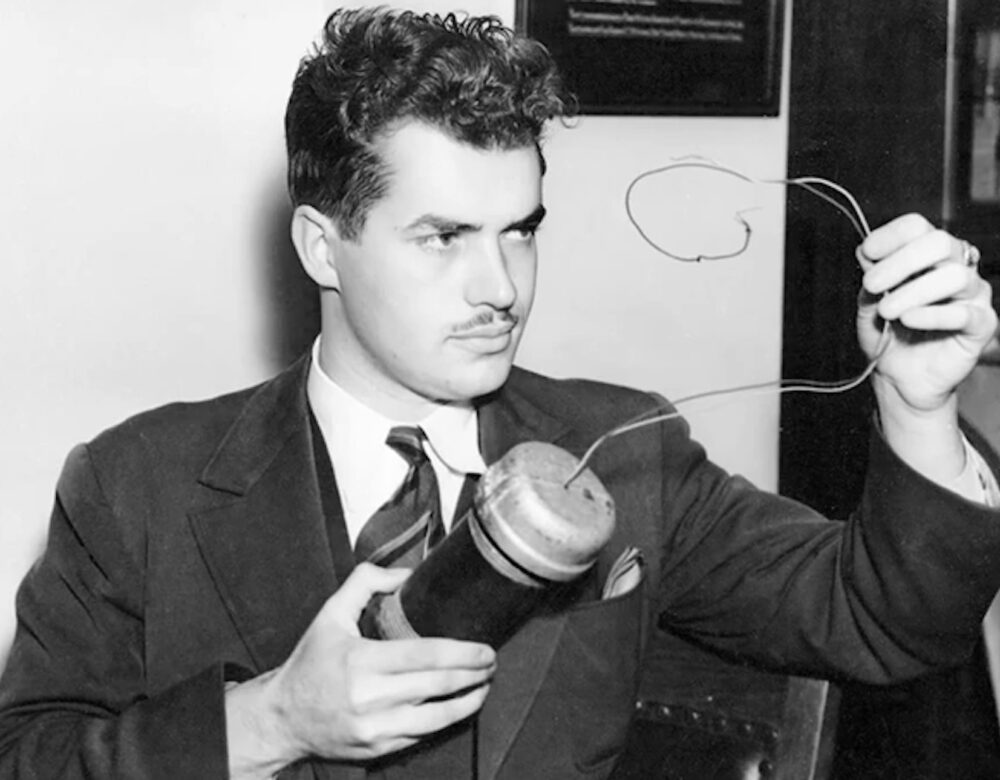
The other man was Marvel Whiteside Parsons, though at different times he called himself Jack, John, and Antichrist. He was one of the most important rocket engineers in America, a principal founder of the Aerojet Engineering Corporation and the Jet Propulsion Laboratory (JPL). He was also a self-taught chemist, with no college degree.
As a boy, he had scorched his backyard launching homemade rockets and was sent to the Brown Military Academy for poor grades and discipline. He was shortly expelled for blowing up the toilets with explosives in a pattern that would follow much of his life. It happened again when he and his childhood friend, Edward Forman, sought to deepen their theoretical knowledge while building a liquid-rocket motor.
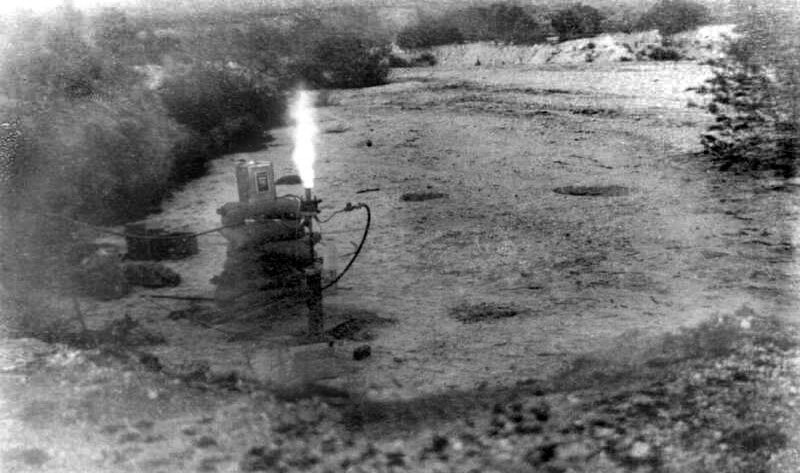
As they talked their way into Caltech, they were referred to a young graduate student named Frank Malina. Malina was almost Parsons’s inverse – rigorous, mathematical, and credentialed – but the two bonded over the same love of science fiction and tales of travel to other worlds. On Halloween of 1936, in the dry canyon wash north of the Arroyo Seco, the three fired their first liquid rocket motor.
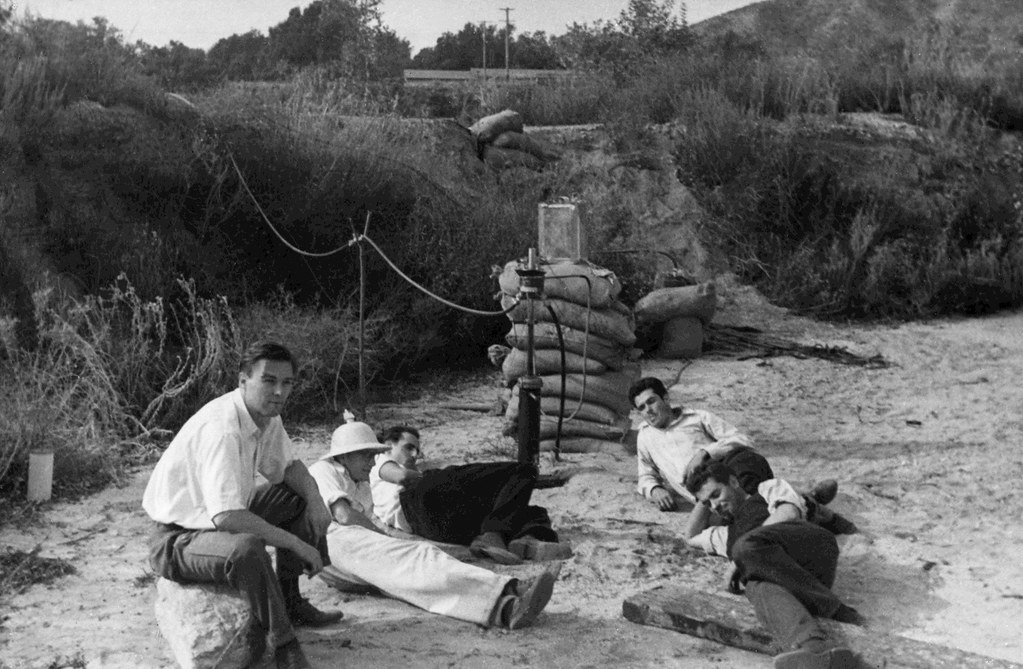
At the time, rocketry stood closer to fiction than to science. Even at Caltech, prominent scientists considered the pursuit deeply unserious, bordering on illegitimate. But under the protection of Malina’s doctoral advisor, the esteemed Theodore von Kármán, the group was allowed onto campus, where they quickly compiled an infamous record.
They killed a large patch of the Caltech lawn after accidentally leaking nitrogen tetroxide across the grass. They were thrown out of the Guggenheim Aeronautical Laboratory (GALCIT) after a misfired motor filled the building with a corrosive cloud of nitrogen dioxide that damaged sensitive equipment. And they nearly killed Malina himself when a prototype detonated in the yard outside and drove a fragment of steel into the wall where he had been standing only minutes earlier, before being called away on an errand involving a typewriter. After that, they were expelled from campus altogether.
Off campus, they were known as the GALCIT Rocket Research Group. On campus, they were known as the Suicide Squad.
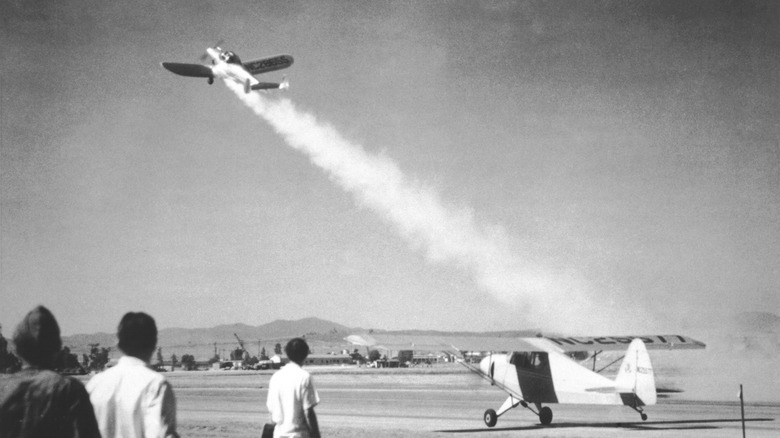
Their exile led them back to their origins at the Arroyo beneath the Devil’s Gate Dam, where Parsons would devote himself to his work religiously. He would perfect a propellant formulation of potassium perchlorate and asphalt in the development of JATOs for the Army Air Corps, helping overloaded bombers launch from short runways in the Pacific, the ancestor to solid-fuel missiles and space-age rocket boosters.
Parsons’s religious devotion was not only figurative. He openly recited Aleister Crowley’s Hymn to Pan before rocket tests and, in those same years, became head of the Agape Lodge, an occult order of the Ordo Templi Orientis, which he soon moved into his Pasadena mansion at 1003 Orange Grove Avenue. There he performed sex magick in pursuit of his True Will, while recruiting tenants through classified ads that specified “does not believe in God.” In Parsons’s eyes, all of it belonged to the same Great Work.
There would be a crater on the Moon named for him, on the far side, where it can never be seen from Earth. And from that dry wash beneath the Devil’s Gate, the Suicide Squad’s testing site would grow into the Jet Propulsion Laboratory, which put rovers on Mars and sent probes far beyond the outer planets of the solar system and into interstellar space.
Among those who remember its beginnings, there is an old joke about what JPL really stood for: Jack Parsons’s Laboratory.
Dynamis
Dynamis, from the Greek dunamis, means power, capacity, or the ability to act.
In Aristotle, dynamis is potentiality, the capacity to become what is not yet, the opposite of energeia or actuality. The marble possesses the dynamis of a statue before the statue exists, a distinction between what a thing can be and what it has become. But Aristotle’s primary sense of dynamis belongs not to the marble but to the sculptor as a principle of change. The marble possesses the capacity to be carved, but the sculptor possesses the capacity to carve.
In Christianity, the word carries a different charge. In Romans, Paul declares the gospel to be dynamis theou, the “power of God”. In this instance, dynamis is no longer an Aristotelian term for potential, but a divine power that crosses a boundary and alters the condition of the world. It is the word Paul reaches for when he speaks of the signs and wonders occurring through the dynamis of the Spirit. The supreme instance of this, the dynamis of God altering the world, is creation, resurrection, and incarnation, when Paul’s God “gives life to the dead and calls into existence the things that do not exist” (Romans 4:17).
Nearly two millennia later, dynamis would itself acquire a physical instantiation in the work of Alfred Nobel. Nitroglycerin, discovered in 1846, had several times the explosive power of black powder, but its extreme sensitivity to shock made it treacherous to handle. Accidents stalked its manufacture and transport, and in 1864, an explosion at the Nobel family’s laboratory killed five people, among them Alfred’s younger brother.
Nobel sought a way to control the power of nitroglycerin in a more stable compound, and eventually found it by absorbing nitroglycerin into kieselguhr. The once-volatile liquid became a malleable paste that could be shaped into rods, inserted into drilled holes, and deliberately detonated with a blasting cap. In search of a suitable name, Nobel returned to the Greek word, dynamis. He called it dynamite.
Yet although dynamite took its name from the older Greek sense of power, its function came closer to the Pauline sense. Nitroglycerin held enormous power, but only in potential and treacherously so. Nobel’s achievement was to make that power effective: dynamite could be stored and utilized at any chosen moment. Its dynamis was no longer merely latent capacity, but a force that could be summoned and made to alter the world.
Jack Parsons was dynamis in every sense of the word. With no degree and no credentials, Parsons was himself a man of unrealized capacity, someone who had yet to officially become. His work as a self-taught chemist consisted quite literally of transforming latent chemical potential into explosive force. What Nobel had done for nitroglycerin, Parsons did for solid rocket propellants. And Parsons would be more than merely a person of great capacity. Like Aristotle’s sculptor, he would become a principle of change himself.
In the Pauline sense, Parsons sought to alter the world through incarnation. The static fire tests in the Arroyo and the Babalon Working in his mansion were performed in different languages, one through science and the other through faith, but they were in some sense the same operation: the calling into existence of things that did not yet exist. In one, science fiction would be incarnated into science, with man traveling among the stars; in the other, Babalon would be incarnated into flesh, into Marjorie Cameron.1 From this perspective, the apparent duality of Parsons, the engineer and the occultist, becomes one. What may seem like Parsons practicing science by day and abandoning it by night was, to him, part of the same Great Work: a life lived in pursuit of manifesting his True Will.
But while Parsons represented an extreme example of dynamis, the civilization emerging around him was beginning to acquire the opposite condition. In the liberal West, dynamis proved difficult to sustain except under the pressure of war. The threat of Hitler showed how quickly an otherwise cautious society could reorganize itself on a massive scale: designing new weapons, raising armies, converting factories into the new cities of industry. But the institutions built after the war were designed above all to preserve what victory had secured, and what followed was a peculiar kind of stagnation that Ross Douthat calls decadence.
A decadent society does not inherently imply impoverishment, obvious decline, or a coming collapse. Rather, a decadent society might remain rich and peaceful, technologically sophisticated, and remarkably stable. But its stagnation appears instead in its inability to turn its extraordinary capacities into genuinely new forms. A decadent society becomes increasingly proficient at maintaining, refining, and reproducing a world that it already knows. In other words, a decadent society is not dynamic but stagnant.
The modern West has become decadent. We have more capital, knowledge, and technology than any preceding civilization in history, but we have failed to turn our abundance into anything of comparable scale. Peter Thiel captured the mood succinctly: “We wanted flying cars, instead we got 140 characters.” Even the digital technologies of the 21st century appear modest besides the physical transformations of the past. The economist Robert Gordon makes the contrast clear with a simple thought experiment: would you rather give up 1) all of the digital technologies of the 21st century, or 2) running water and the flush toilet?
Measured in this way, imagination, ambition, and knowledge are insufficient in any combination to escape decadence. A civilization may conceive of a grand future, possess the means and resources to realize it, yet still fail to act. It may possess dynamis, but by itself, without the conversion to energeia, without incarnation, it remains only potential.
The Saturn V rockets that carried first Neil Armstrong and, finally, Eugene Cernan represented a tremendous achievement not merely in the technical sense, but in the metaphysical one: a society transforming what had existed in imagination into material form. Apollo 11 landed on the Moon only eight years and two months after Kennedy announced the goal of reaching it. And the Apollo program itself, spurred by the Cold War, may have been the last great incarnation of dynamism within the postwar liberal order. For Parsons, it would have represented the fulfillment of his lifelong dream of reaching the Moon, the actualization of the science fiction he had devoured as a boy: men traveling among the stars, fantasy incarnated at last in fire and steel. Dynamis becoming energeia. Transcendence made real.
Yet the civilization that followed would possess vastly more technological power while appearing increasingly less capable of such acts. A single iPhone contains vastly more computing power than the computers that guided Apollo to the Moon, yet no human being has walked there since 1972. But the rocket that had carried men to the Moon always contained another possibility. The same technology that could carry man beyond Earth could also carry weapons across it. The difference was never in the machine but in the direction its dynamis was directed.
Parsons would embody these divergent possibilities in the two institutions that he helped found. JPL turned outward towards the heavens, sending machines to the Moon, Mars, and eventually beyond the solar system. Aerojet turned inward to man, developing the propulsion systems that would place entire cities within range of annihilation. And from the rockets, Parsons would leave us a crucial choice: towards transcendence or towards apocalypse.
Pax et Securitas
In 1948, the United States government deemed Jack Parsons a security risk. Within a few years, his clearance was permanently revoked, and he was pushed to the margins of his company and the field he helped found.
With Hitler dead and, for the first time, nuclear annihilation a real possibility, the postwar liberal order began its own refounding. But unlike the wartime order, organized around decisive goals to be achieved, the new order would increasingly reorganize itself around prevention: prevention of another Hitler, another Holocaust, another World War, another Hiroshima or Nagasaki. Never Again would become its founding principle, and from this emerged a new political ideal: peace and security.
There is something strangely apt about the word security, and the way governments adopted it. After the catastrophes of the twentieth century, security represented a genuinely desired protection from the horrors that had just occurred. But it would also become one of the characteristic languages of the postwar order, a legitimizing term through which restrictions, secrecy, surveillance, and exceptional powers could be justified. It was the language in which Parsons lost his clearance, and the language invoked decades later by secret FISA courts and mass-surveillance programs revealed by Edward Snowden.
But there is a much older tradition of peace and security that is more revealing. In Latin, it is pax et securitas.
After decades of civil war, the great promise of Augustus was Pax. The Senate would consecrate the Ara Pacis and only under Pax Romana could prosperity, fertility, and order truly flourish. For the Romans, Pax held great political power, and so Pax was incarnated as a goddess, monumentalized on altars and stamped onto coins. She would be depicted standing upright, carrying an olive branch, representing not merely the absence of war but the justification of imperial rule.
Securitas comes from securus: se, without, and cura, care, anxiety, or concern. To be secure was, literally, to be without care, without concern. Cicero used securitas in this way to describe a peace of mind in which fear no longer governs the individual. But it would not be until Nero’s reign that Securitas would appear incarnated as a goddess on Roman coins. In contrast to Pax, Securitas appears seated almost languidly upon her throne with her head at rest and a scepter in her hand – assurance that there was nothing left to fear. But the word securitas contains an ambiguity that later took on another significance. To be without care could also be understood, in the literal sense, as careless or negligent. And to become entirely without care is also to risk not recognizing the danger yet to arrive.
A decade before Securitas would be inscribed, another Roman citizen had written to a small Christian community in the Greek city of Thessalonica, in what would be the earliest surviving Christian text. Paul would warn them of the coming Day of the Lord:
For when they shall say, Peace and safety; then sudden destruction cometh upon them, as travail upon a woman with child; and they shall not escape. 1 Thessalonians 5:3
“Peace and safety,” in the Latin Vulgate, translates directly as pax et securitas. What Rome understood as the promise of a successful civilization, Paul recasts as the language of the eschaton. The moment a civilization declares itself safe, when it becomes, in the literal sense, securus, without care, is precisely the moment when sudden destruction arrives. For when the child of the apocalypse is born, the world will have become too secure to care.
Apocalypse, in its original Greek apokalypsis means unveiling, a revelation. Properly understood, an apocalypse is not necessarily the moment the world is destroyed, but instead the moment the world reveals its hidden mechanism.
Nearly two millennia later, the Russian philosopher Vladimir Solovyov would imagine precisely such an apocalypse in his Short Story of the Antichrist. Published in the final year of his life, Solovyov’s Antichrist bears little resemblance to the obvious monster of popular imagination. Instead, he is a universally admired young man: handsome, brilliant, intellectually accomplished, philanthropic, humanitarian, even vegetarian. He manages to reconcile all the world’s philosophies and faiths in a book titled The Open Way to Universal Peace and Prosperity. Elected by the governing body of Europe and eventually proclaimed emperor of the world, he abolishes war, feeds the hungry, and establishes an unprecedented unity among mankind. He proclaims peace to all peoples, and they believe him.
Solovyov’s Antichrist is not simply evil disguised as good. He entertains a more troubling possibility that the good might, in some sense, be genuine and real. Nearly anything mankind wants, the Antichrist delivers: peace, security, unity, a world freed from hunger and conflict. Even when he confronts the remaining Christians, he offers them what they claim to value: to the Catholics, authority and splendor; to the Orthodox, their ancient traditions; to the Protestants, intellectual freedom. But he is willing to give Christianity almost anything except for Christ. Peace becomes a substitute for salvation and transcendence. A good life becomes a substitute for asking questions about what lies beyond. At the end of war and the end of desire, universal peace and safety are not presented as the defeat of the Antichrist but precisely his doing.
There is an uncanny coincidence hidden inside Paul’s warning. Securitas was stamped onto coins under the reign of Nero, and in those exact years, Rome burned. Much of the city was destroyed, and Nero, seeking to deflect suspicion, blamed it on the Christians who were subjected to brutal persecution. Many were crucified, torn by dogs, and set alight as torches to illuminate his imperial gardens. But perhaps securitas was written because Rome was no longer secure. The inscription on the coins did not describe reality as it was, but rather it was a concealment of it. The coin bore a false image of peace and security, just as the apocalypse would bear a false image of Christ.
Even further, in the Book of Revelation, Saint John reveals the number of the Beast to be 666. Nero’s Hebrew name, Neron Kaisar, when calculated through gematria, amounts to 666, and even after his death, rumors spread that he had not truly died and would return, according to the Sibylline Oracles, “equal to God” in the legend of Nero Redivivus. And it would be under Nero, the emperor of Securitas, and the suspected Antichrist-like figure, that Paul himself was executed.
Paul had written another, peculiar warning to the Thessalonians. He told them that before the Lord could arrive, there must first appear a “man of sin,” a figure whom later Christian tradition would identify with the Antichrist. In the older Greek manuscripts, the man of sin went by a different name, ho anomos, “the man of lawlessness.” Except, this man could not yet reveal himself because something held him back.
And now ye know what withholdeth, that he might be revealed in his time. For the mystery of iniquity doth already work: only he who now holdeth back will hold him back, until he is taken out of the way. And then shall that Wicked be revealed 2 Thessalonians 2:6–8
That restraining force would become conceptualized as the katechon – that which holds back. Only when the katechon was removed could the lawless one be revealed and the apocalypse unfold.
The German political theorist Carl Schmitt would make the katechon central to his political theology. For Schmitt, the Christian empire could be seen as the historical restrainer whose task was to prevent the Antichrist's arrival and postpone the coming apocalypse. Yet in Christian eschatology, the return of Christ, the parousia, and the redemption of the world appears only after the arrival of the Antichrist. The katechon, therefore, by holding back the Antichrist, would also indefinitely delay the parousia and the redemption of all mankind.
The postwar West can be understood in much the same way. It could articulate no resounding future, but only a past that must never recur. Never again as its founding principle is inherently preventative and, to a large degree, katechontic. And it would quickly adopt pax et securitas as its defining imperative. The very first line of Article 1 of the United Nations, the founding charter of the new world order, stated its purpose succinctly: “To maintain international peace and security… for the prevention and removal of threats.” The language of the eschaton, “peace and security”, as well as the language of the katechon, “prevention,” is explicitly stated, and its only verb is “maintain.”
Two years later, the National Security Act of 1947 would reorganize the American state around the same principle, establishing the National Security Council alongside the Central Intelligence Agency, institutionalizing a new language of national security. For a liberal order founded in part upon the refusal to answer the highest political questions, the new language of security was especially embraced. But for Carl Schmitt, who argued that the essence of the political lay in the fundamental distinction between friend and enemy, the shift of politics into security would dissolve that distinction. While a clear enemy could be unmistakably defeated, incessant threats to national security could only be managed and contained. Only under the condition of war could an enemy be sufficiently distinguished.
But the nature of the weapons with which that distinction could ultimately be decided would radically change. Alfred Nobel had glimpsed that logic early in his own dynamite. He suggested to the pacifist Bertha von Suttner that perhaps his factories might put an end to war sooner than her congresses – that on the day two armies could annihilate each other in a second, all civilized nations would recoil in horror and disband their troops. Although his logic was sound, Nobel had vastly overestimated the power of his dynamite, and severely underestimated mankind’s capacity for violence.
Even Nobel, the “merchant of death,” would also speak in the language of peace and safety. He had considered naming dynamite Nobel’s Safety Powder, and the fortune it made him would later endow the Nobel Peace Prize dedicated to the foremost individuals who advanced the cause. And he imagined that peace itself might be achieved most quickly through weapons of overwhelming destructive power.
The world after 1945 would prove him right. A war on the totalizing scale as the one that had just ended would only end in a pyrrhic armageddon. The atomic bomb and the vastly more destructive hydrogen bomb, carrying over billions of times the explosive capacity of dynamite, would ensure that the destruction of the enemy would not only result in the destruction of the victor, but perhaps the entire world.2 All the while, the means of delivery would also drastically improve. Jet-powered strategic bombers, nuclear stealth submarines, and intercontinental ballistic missiles ensured that the end of the world was never more than mere minutes away.
Such weapon of the apocalypse would be of almost pure dynamis. Hiroshima and Nagasaki had twice before incarnated its devastating raw power, but after the war the exact nature of their use would be in their non-use. So long as its dynamis never became energeia, the Bomb would itself be katechontic, a weapon of deterrence held perpetually in reserve, hidden in secret beneath the oceans or buried under a farmfield in Kansas. In its most powerful weapon, the postwar order would manifest its own creed of anti-incarnation, for once that potential became actual, apocalypse would soon follow. The Bomb would paradoxically become not only the katechon of nuclear apocalypse but also its instrument.
And for the states that possessed it, the Bomb would become a weapon of peace and safety. Mutually assured destruction enabled a security that no conventional arsenal could have ever provided. Instead of large-scale invasions, there would be espionage, coups, and proxy conflicts. Instead of conquest, there would be open borders, economic integration, and cultural exchange. States, institutions, corporations, and the individual would all become entangled across borders to a degree scarcely imaginable before the war. What followed would be the longest period of continual peace among Europe’s great powers in modern history, and it would be eerily similar to the same peace and safety that Solovyov’s Antichrist had produced.
It was within this katechontic peace that Jack Parsons would be stripped of his security clearance. Parsons, perhaps more than any other man of his age, represented dynamis in its incarnating form. He did not merely imagine rockets and goddesses, but devoted himself to manifesting their existence, and by his own reckoning had succeeded in both.
The West had needed Parsons to win the war, but the peace he had helped build had far less use for him. By the time his clearance was finally revoked, he had already been pushed out of his own company, the Aerojet Corporation. Aerojet would go on to build the propulsion for nearly every American ballistic missile that followed: Titan, Polaris, Minuteman, Peacekeeper. And interestingly, in 1962, the first American to reach orbit would ride an ICBM in the name of peace: Friendship 7.
But the katechon of the postwar order had identified something more dangerous in Parsons. He almost seemed to answer Paul’s description of ho anomos, the man of lawlessness. He had no degree and little deference to institutional authority, freely experimenting with explosives in his own home. He practiced a religion widely regarded as obscene and taboo, and recognized no higher law than the Law of Thelema: “Do what thou wilt shall be the whole of the Law.” In 1948, the same year his security clearance was first suspended, Parsons swore his “Oath of the Antichrist” and assumed the name Belarion Armillus Al Dajjal – Armillus, the anti-Messiah of Jewish eschatology; Al-Dajjal, its Islamic counterpart.
Taken literally, Parsons was almost certainly not the Antichrist. He was not the deceptive figure who was prophesied to conquer the world into a universal state. But as the symbolic figure whom a katechontic age existed to restrain, he became one of its sharpest critics. In Freedom Is a Two-Edged Sword, Parsons warned of a society increasingly willing to surrender freedom in exchange for security, and saw the same transformation already overtaking science: “Science… is regimented, strait-jacketed and scared; its universal language is diminished to one word, security.” The man of lawlessness had recognized the emerging law of the postwar world.
Alexandre Kojève, lecturing Hegel in Paris in the 1930s, described the culmination of history in a universal and homogeneous state, where the struggle for recognition that had driven men to transform the world would at last be fully satisfied. There would be no genuine political alternative left to realize. Events would still continue, but the struggle over the ultimate form of human society would be settled. Nothing would remain to be founded, and everything left to be maintained. Kojève called it the end of history.
But a darker interpretation of this ending exists. The hard political questions disappear not because they have been answered but because mankind has chosen to abandon them. A civilization could become so satisfied with its condition that it ceases to ask what lay beyond it. Peter Thiel, drawing on Schmitt, describes what such a world could resemble:
In such a unified world, “what remains is neither politics nor state, but culture, civilization, economics, morality, law, art, entertainment, etc.” The world of “entertainment” represents the culmination of the shift away from politics. A representation of reality might appear to replace reality: instead of violent wars, there could be violent video games; instead of heroic feats, there could be thrilling amusement park rides; instead of serious thought, there could be “intrigues of all sorts,” as in a soap opera. It is a world where people spend their lives amusing themselves to death. Peter Thiel, The Straussian Moment
Parsons would spend his final years supplying that world of entertainment. With his access to classified rocket work revoked, he would instead make explosions for Hollywood, producing pyrotechnics, artificial fog, and other special effects in his small home lab. Parsons, who had started his life turning the imaginary rockets of science fiction into reality, would end it by making real explosions imaginary. In June 1952, while preparing a rush order of explosives for a film, Parsons would be killed at the age of 37 in an explosion.
The nuclear arsenals of the postwar era would also find their purpose in “a representation of reality” that appears to “replace reality.” Nuclear war between the superpowers would be fought exclusively in war games and computer models. Simulation would become the only acceptable arena in which such a war could be fought. The world could end again and again on big screens in small war rooms, permitted it never ended in reality. But nothing guaranteed that war would remain within its simulation. So long as any rival state retained its sovereignty over the Bomb, nuclear armageddon would always remain possible.
But as early as 1946, the short film One World or None, sponsored by the National Committee on Atomic Information (NCAI), proposed an eerily familiar solution to the apocalypse. It called upon the United Nations, as an “imperative necessity,” to establish global control of atomic energy and other weapons of mass destruction. The Bomb would thus become the “great fusing force” compelling “all people in all nations” to become one world and enact laws that abolish war. The Bomb had given an ultimatum: “life or death”; One World or None.
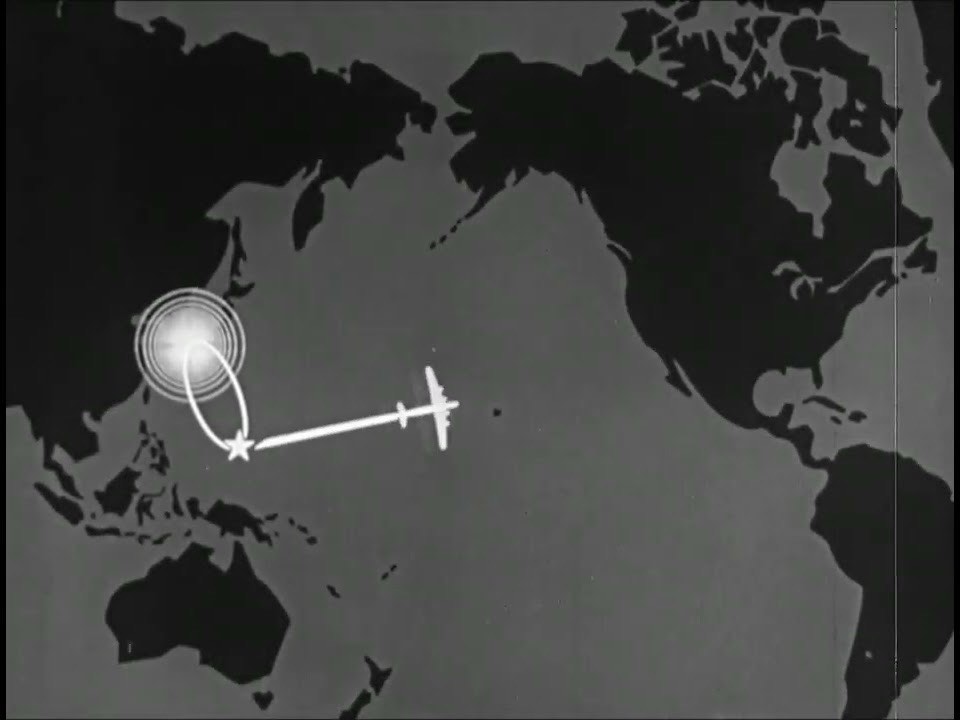
Prevention was the path taken toward the universal and homogeneous Kojèvean world state. The Bomb had transformed political division itself into an apocalyptic danger. The solution proposed by the NCAI was therefore not solely peace between nations, but a central authority capable of restraining any powers that could lead to nuclear war. And this would also be the strange genius of Solovyov’s Antichrist, who by dissolving war and division, would become emperor of the world. The Antichrist did not arrive as the enemy of pax et securitas, but as their guarantor.
But such a state would occupy a peculiar theological position. Its legitimacy would derive from its ability to hold back the apocalypse. Solovyov’s universal order is sustained through the preservation of peace and unity. The world envisioned in One World or None is sustained through the prevention of nuclear annihilation. In either case, the final political order, the universal one-world state, assumes the role of katechon by restraining mankind’s latent capacity for self-destruction.
But in Solovyov’s story, the katechontic state is ruled by the Antichrist himself. How could the Antichrist take power within the very katechon whose purpose was to prevent his arrival?
The contradiction may be only apparent. The power created to prevent the emergence of a final world order could therefore become the very mechanism through which that order arrives. The Antichrist would not need to defeat the katechon, but he would inherit it. Instead, the katechon could fail by succeeding too completely. In restraining every force capable of producing the supposed Antichrist’s one-world state, it could become one itself, gradually producing the very order it had existed to prevent. Viewed from this perspective, Solovyov’s Antichrist is much less paradoxical.
But in Christian eschatology, the katechon does not merely postpone the apocalypse, but the entire sequence that leads to the end of history. Only after the katechon is removed can the Antichrist be revealed, and only beyond the Antichrist lies the return of Christ himself. To hold back the Antichrist indefinitely is therefore to hold back Christ indefinitely. And there is only one figure in the whole of Christian eschatology whose purpose is to hold back Christ. The katechon, then, becomes an obvious candidate for the Antichrist, a brilliant deception. The figure expected to arrive could hide himself in the very mechanism designed to prevent his arrival. And, like in Solovyov’s story, he would not need to oppose Christ openly, but only preserve the world indefinitely.
At the end of History, there need not be an apocalypse or an Armageddon. The world could simply remain suspended, preserved by its own peace and safety until permanence calcifies into stagnation and decadence. Nothing new would ever arrive, and neither would Christ.
The Fairy Tales of Science
Many a night from yonder ivied casement, ere I went to rest,
Did I look on great Orion sloping slowly to the West.
Many a night I saw the Pleiads, rising thro’ the mellow shade,
Glitter like a swarm of fire-flies tangled in a silver braid.
Here about the beach I wander’d, nourishing a youth sublime
With the fairy tales of science, and the long result of Time;
When the centuries behind me like a fruitful land reposed;
When I clung to all the present for the promise that it closed:
When I dipt into the future far as human eye could see;
Saw the Vision of the world and all the wonder that would be. Alfred, Lord Tennyson; Locksley Hall
In 1835, Alfred Tennyson wrote Locksley Hall, a poem spoken by a young man looking backward on his life and forward toward the future. Tennyson has him look upward toward the stars, nourishing himself on what he calls the “fairy tales of science.” To him, science did not empty the universe of mystery, but instead widened the bounds of what might be possible, holding out the promise of a future stranger and more wonderful than the present.
There is, however, an apparent irony contained in the phrase fairy tales of science. From a first approximation, these two terms seem almost opposed. Fairy tales belong to a world of the imagination, a place of enchanted forests and impossible creatures. Science belongs to a world of observation and experiments, the stubborn reality where things are meticulously measured and must be proven to exist. One concerns what might be, while the other with what is.
Yet for Tennyson, there was no contradiction at all. Science was precisely what made the unbelievable believable. It did not merely explain the world that already existed but revealed that the boundaries of reality itself could be expanded into the domain of fairy tales. In fact, Tennyson had experienced this for himself. Around the time he wrote Locksley Hall, England began installing steam locomotives that carried passengers between cities at unprecedented speeds. His first ever trip between Liverpool and Manchester would inspire in the very same poem:
Not in vain the distance beacons. Forward, forward let us range,
Let the great world spin for ever down the ringing grooves of change.
But Tennyson did not stop with the marvels already before him. He would dip into the future once more and imagine what wonders that might follow:
Saw the heavens fill with commerce, argosies of magic sails,
Pilots of the purple twilight dropping down with costly bales;
Heard the heavens fill with shouting, and there rain’d a ghastly dew
From the nations’ airy navies grappling in the central blue;
Far along the world-wide whisper of the south-wind rushing warm,
With the standards of the peoples plunging thro’ the thunder-storm;
What he had envisaged was astonishingly close to the shape the following century would take. Powered flight remained more than sixty years away, yet Tennyson already saw with surprising clarity its double nature. The heavens would fill first with commerce and then war. The same “magic sails” that carried goods through the sky would also allow nations to rain destruction upon one another from above. Even more revealing still was what Tennyson imagined would follow the war:
Till the war-drum throbb’d no longer, and the battle-flags were furl’d
In the Parliament of man, the Federation of the world.
There the common sense of most shall hold a fretful realm in awe,
And the kindly earth shall slumber, lapt in universal law.
He would predict that the violence of war would eventually culminate in the end of war itself. As the battle-flags were furled, political division would give way to a new unified political order, a “Parliament of man” and a “Federation of the world,” where earth itself could “slumber, lapt in universal law.”
The resemblance to the end of History described by Kojève, and to the world imagined by Solovyov, is difficult to ignore. Tennyson’s technological future terminates in much the same universal and homogeneous one-world state, where political order would be overcome and war restrained. He had not only anticipated the institutions that would later resemble the United Nations, but a peculiar stillness in the slumber that would follow from their ultimate success.
Tennyson, however, could not bear to leave the world still. He would have the young man’s daydream break off almost as soon as the earth slumbers under universal law, and what follows is an impatience with almost anything that ceases to move. “Science moves, but slowly, slowly,” he complains; “Better fifty years of Europe than a cycle of Cathay.” His answer to the stillness of the One World is indeed movement and progress. He would rather see men perish one by one than watch the Earth “stand at gaze like Joshua’s moon in Ajalon.” For Tennyson, a dynamic world with all its dangers was preferable to a stagnant one secured against them.
A dynamic world is the opposite of a stagnant world, and the word itself descends from the Greek dynamis. A dynamic world possesses the power to change and to become something it is not yet. But dynamis holds only capacity, it cannot determine what to be. Aristotle’s sculptor possesses dynamis because he has the power to transform the marble, but this power alone gives him no form toward what to carve. Before his chisel touches the stone, he must first see beyond it, into a world of myth, gods, heroes, and saints, and only from there does he know what to sculpt. Every great act of creation therefore requires something transcendent, something beyond the world as it presently exists.
It is through this idea of transcendence that fairy tales acquire their peculiar importance. A fairy tale opens up another world, one of myth, legend, and ideal. Its power lies precisely in the distance between that world and our own, that it remains different from reality as it presently exists. It gives us something to dream about and to move toward, something to pursue, some image of a reality still beyond our reach. In doing so, it prevents the stillness of the present from becoming final.
And yet Tennyson’s own fairy tale stops short. The young man commences the poem by looking upward toward Orion and the Pleiades, constellations whose names themselves descend from ancient tales and myth, yet he never imagines actually going to them. However far his imagination ranges, even with all sorts of “magic sails”, his vision of the future remains confined in the heavens above Earth, in its atmosphere of thunder and war, eventually returning toward the “kindly earth” under universal law. The problem was not that he had dreamed too extravagantly, but on the contrary – he had not dreamed far enough. His fairy tale had conquered the skies and left nowhere further to go.
However, about a century later, rockets would introduce the possibility of leaving Earth altogether. And, like Tennyson, it also contains the same double nature he had envisioned. A spacecraft and a ballistic missile are, in essence, variations of the same machine, but their difference lies in the speed at which they are flown. With enough velocity, a spacecraft can escape the gravitational pull of Earth and continue outward toward another world. A ballistic missile, however, is designed never to reach escape velocity, falling back to the world below, carrying destruction and raining Tennyson’s “ghastly dew.” It was with an ominous resonance, then, that Paul had warned: “they shall not escape.” The rocket thus embodied in a single machine the two paths technological power could take: transcendence or apocalypse.
And they, too, had begun as fairy tales. Long before Parsons ever fired a motor in the Arroyo Seco, he had encountered spaceflight in fiction, devouring Jules Verne and pulp magazines like Amazing Stories. Edward Forman and Frank Malina had read many of the same tales, while beyond Pasadena, Wernher von Braun had grown up on H. G. Wells and was likewise an admirer of Verne. What distinguished these men was their refusal to accept fairy tales as merely tales. Science would ensure that fairy tales could be assimilated into reality and produce a dynamic world of progress. But to do so required some sort of faith, a faith in both science and the tales themselves.
The faith these men required was not simply faith in science as an authority. One could trust science and its method completely to determine truth, yet have very little faith in what science might make possible. Modern society may still defer to scientific expertise and expect gradual technological improvement, but it has become far less willing to believe that the world itself might become radically different from the one already before us. What has faded is the transcendent quality that guided Tennyson and Parsons in science, a sense that reality still concealed unknown secrets, and their unveiling would transform the world beyond recognition.
There has emerged, in modern culture, a suspicion that there are perhaps no such worlds left to discover, that perhaps we have arrived at the end of science itself. For three centuries, physics has carried enormous momentum from Newton to Maxwell, relativity to quantum mechanics, each overturning, sometimes inconceivably, the picture of reality left by the last. But by the end of the twentieth century, it had become possible to wonder whether the great revolutions were over. String theory, once heralded as the route beyond the Standard Model, disappeared ever further into mathematical abstraction without producing anything meaningfully comparable to the breakthroughs that had preceded it. Like Kojève’s end of History, there appeared to be an end of Science, as John Horgan would aptly name it. Science, alongside its familiar rituals of experimentation and publication, would certainly continue, but its future would consist increasingly of elaborating upon past foundations rather than revealing entirely new ones.
But the suspicion that science might be approaching an end was itself a pathological symptom. The Enlightenment ideal of rationality had gradually pushed mystery out of the world. Max Weber, writing less than a century later, would famously describe modernity as entzaubert, disenchanted. Nature no longer appeared governed by mysterious and incalculable forces, and whatever remained unknown was assumed, at least in theory, to be knowable. The science that had once seemed to reveal invisible worlds would increasingly, in its triumph, consist in leaving no hidden world beyond explanation. The map of reality itself seemed rapidly to be filling in. Wherever one went, one would no longer be the first – the frontier closed, and nowhere left to go.
Such a disenchanted world without mystery breeds a different kind of science. If there seems to be nothing fundamentally new left to discover, then what remains is to measure what is known more precisely, to calculate to ever greater decimal points, and preserve what has already been established. Discovery gradually gives way to incessant optimization, while science itself hardens into a defensive and protective institution. The unknown becomes less a frontier to explore than a source of risk. What Horgan called the end of science, Douthat decadence, and Thiel indefinite optimism may therefore be different descriptions of the same condition: an enormously powerful civilization that has ceased to expect revelation.
Likewise, Parsons had also recognized this same condition decades earlier. He had watched science itself become regimented and constricted, “strait-jacketed and scared,” until, as he put it, its universal language had been diminished to a single word: security. The disenchantment of the world, and eventually of science itself, followed naturally from the logic of a civilization built upon securitas. Securitas promised a condition without cura, without care. Yet cura was also the root from which curiosus, eventually curiosity, took its name. A science organized all around security risked extinguishing the very essence which discovery relied upon. What pax et securitas had done to politics, securitas now threatened to do to science. There would be constant activity on university campuses, but remarkably little change. The same disciplines would remain in place, taught by the same institutions, divided into the same departments, studying increasingly narrow questions within boundaries established long before. There would be more papers, more citations, more conferences, and more specialization, but fewer attempts to redraw the map itself.
Peter Thiel tells a revealing story about Robert Laughlin, the Stanford physicist who won the Nobel Prize in 1998. Laughlin had assumed that a Nobel Prize would afford him genuine academic freedom, and so he turned his attention toward whether parts of Stanford’s scientific establishment were producing genuine scientific progress at all. According to Thiel, his funding soon disappeared, and his graduate students encountered difficulties completing their degrees. Even a Nobel Prize offered little protection once the question shifted from what can be discovered to whether the field itself is discovering anything at all.3
Our loss of faith in science can be seen clearly in the zeitgeist of popular culture. Stanley Kubrick’s 2001: A Space Odyssey, depicted a world of enormous space stations orbiting the Earth, permanent bases on the Moon, and human expeditions to Jupiter. At the time of release in 1968, the film was set only thirty-three years in the future. In retrospect, such a world now seems almost fantastical, but Kubrick’s obsession with realism depended upon the assumption that audiences could plausibly imagine it arriving by 2001. With men about to walk on the Moon, the science fiction tales of the sixties presented technology as a means toward a transcendent future. However, in the decades that followed, this narrative increasingly reversed. Films like The Terminator imagined advanced technology escaping human control and culminating in apocalypse. In Gravity, the entire plot consists of escaping space itself and making a desperate return for Earth, the one and only habitable refuge. There would still be fairy tales of science, of course, but transcendence had ceased to be their promise.
If the American path toward the stars had produced Jack Parsons and the Suicide Squad, the Russians had produced an equally improbable figure in Konstantin Tsiolkovsky. Like Parsons, Tsiolkovsky spent much of his life far from the scientific establishment, working in relative isolation, and imagined technologies that scarcely belonged to any respectable scientist of his age. In 1903, he derived the mathematical relationship of spaceflight, now known as the Ideal Rocket Equation, and was the first to argue liquid-propelled rockets could make spaceflight feasible, carrying humanity beyond Earth. Decades before Parsons began firing crude motors in the Arroyo Seco, Tsiolkovsky had already worked out much of the mathematics by which the fairy tale of spaceflight might become real.
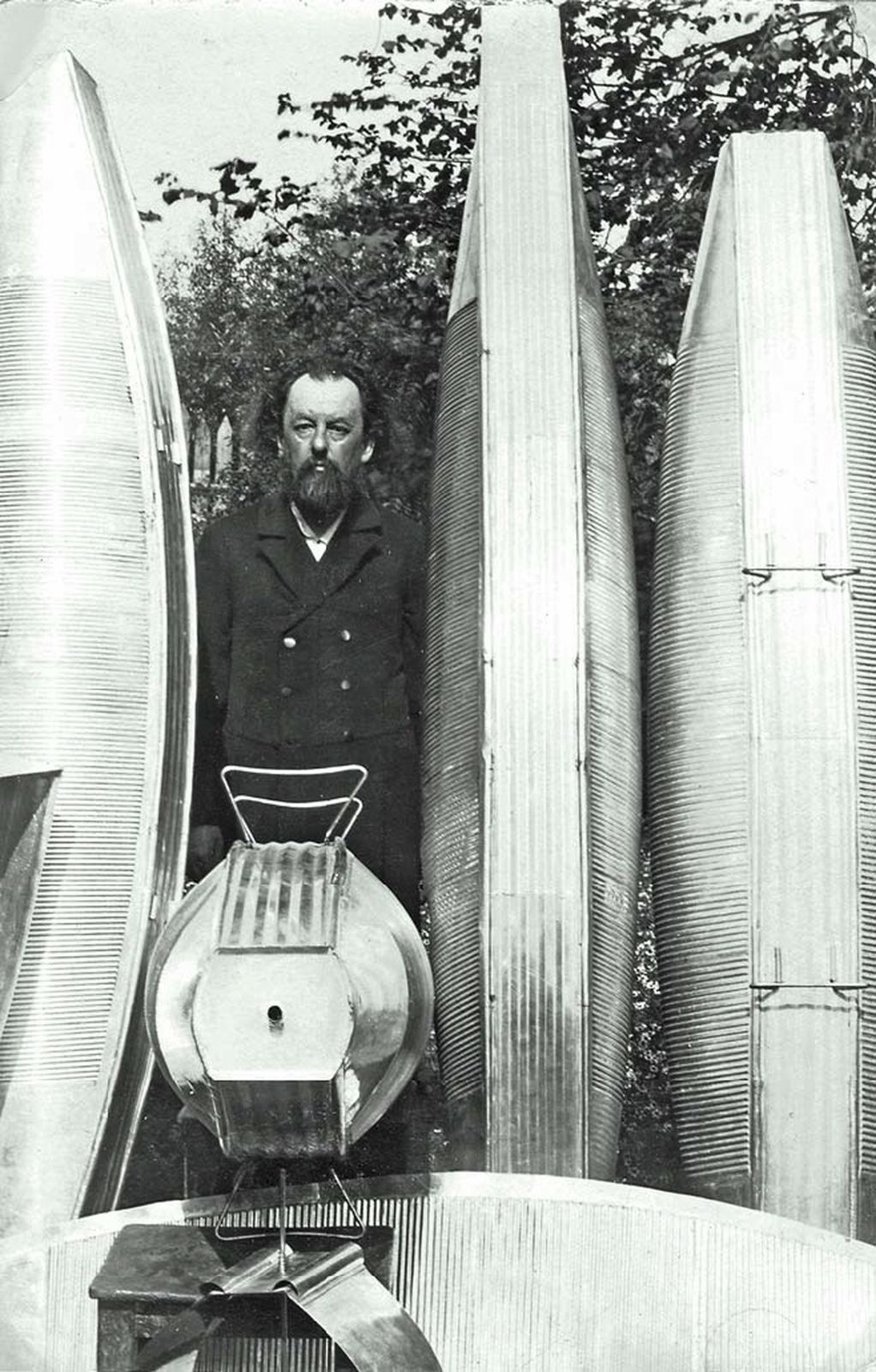
Like Parsons, Tsiolkovsky found much of his inspiration in the tales of Jules Verne, but his imagination was also rooted in a stranger and more unconventional intellectual world. As a young man in Moscow, he came under the influence of Nikolai Fedorov, an eccentric librarian and Christian philosopher whose ideas would become the foundation of Russian Cosmism. Fedorov believed that mankind’s task was not to wait for the resurrection promised by Christianity, but to bring it about themselves through scientific advances. He called this the Common Task, the literal resurrection of every human being who had ever lived. The sheer amount of people would eventually require mankind to expand beyond the confines of Earth and settle new worlds. Tsiolkovsky would inherit much of this cosmic faith himself. He came to see the colonization of space not merely as exploration, but as part of the transformation and perfection of humanity itself, a future in which death might be conquered and immortality made possible. Only out in the cosmos could humanity transcend itself.
For Tsiolkovsky, science alone was never enough. The equations could explain in extraordinary detail how a rocket might leave the Earth, but they could not explain why anyone should want to. That reason came from Verne, from Fedorov, from religion and myth, from the conviction that mankind was destined for a future radically different from its present. Science supplied the means, but the tales supplied the reason and destination. Tsiolkovsky would later express the idea in a single famous line: “Earth is the cradle of humanity, but one cannot live in the cradle forever.” The purpose of the rocket was not merely to enter orbit, but to leave the cradle altogether.
Parsons’s rocket and Tsiolkovsky’s answer seem to provide an alternative to the ultimatum presented by One World or None. So long as mankind remained confined to a single world, technological progress seemed destined either to culminate in mutual destruction or in some singular katechontic world state capable of preventing it. But instead of resolving political differences by compressing mankind into One World, humanity might for the first time choose to escape this world entirely. Indeed, Carl Schmitt had written that “the political world is a pluriverse, not a universe.” The rocket now gave that distinction a literal meaning. The answer to One World need not be none at all, but many.
For Schmitt, the political depended upon the continued existence of distinct peoples capable of distinguishing friend and enemy. Once every meaningful difference had been absorbed into a single universal state, that crucial distinction would disappear. At Kojève’s end of History, at the universal and homogeneous state, there would be no friend and enemy and no genuine politics left. The friend-enemy distinction is precisely what gives politics its dynamis, its potential to change, and prevents the world from lapsing into Tennyson’s “slumber” beneath a final order. What the pluriverse preserves, then, is not conflict for its own sake, but the existence of alternatives, that somewhere there is another order, another frontier, another place from which something new might be conceived.
The pluriverse might therefore offer a restraint that the katechon itself could not. The katechon sought to hold back the Antichrist by preserving order, but taken to its logical extreme, that preservation could harden into the end state it had existed to prevent. But the pluriverse restrains universal power in precisely the opposite way. Instead of closing the world, it restrains by opening it. No single order could ever become final because plurality itself would remain built into the very structure. The Antichrist might conquer the Earth, but so long as mankind could still look beyond it, he could never make his world complete.
Douthat offers one possible escape from decadence in a single line: “decadence ends with people looking heavenward: toward God, toward the stars, or both.”
Transcendence guarantees that the world before us is not the final world, that beyond every earthly order there remains another reality still to come, a heaven not contained in the present one. This is why Solovyov’s Antichrist could offer the Christians almost everything associated with their faith that still belonged to the world he ruled. Everything except Christ himself because Christ pointed beyond his One World empire, beyond its peace and order, toward a world that had not yet arrived. The Antichrist could tolerate religion only so long as religion ceased to transcend the world. He might conquer the Earth, but he could not let mankind believe Earth was the end.
The stars offer the same promise in material form, but unlike heaven, where faith alone may be enough, faith in the stars is only the beginning. It is not enough merely to look toward them from Tennyson’s “ivied casement.” If they are to provide an escape from One World, mankind must actually strive toward them. The fairy tale can reveal other worlds, but only science can carry us there. However transcendent the vision, it must eventually pass through the stubborn resistance of the physical world before it can become real.
We will need faith in both, in Heaven and the stars. There is only one path away from Antichrist and apocalypse, and that is up.