Dominion
if there were gods, how could I endure it to be no God! Friedrich Nietzsche — Thus Sprach Zarathustra
The Fear of Playing God
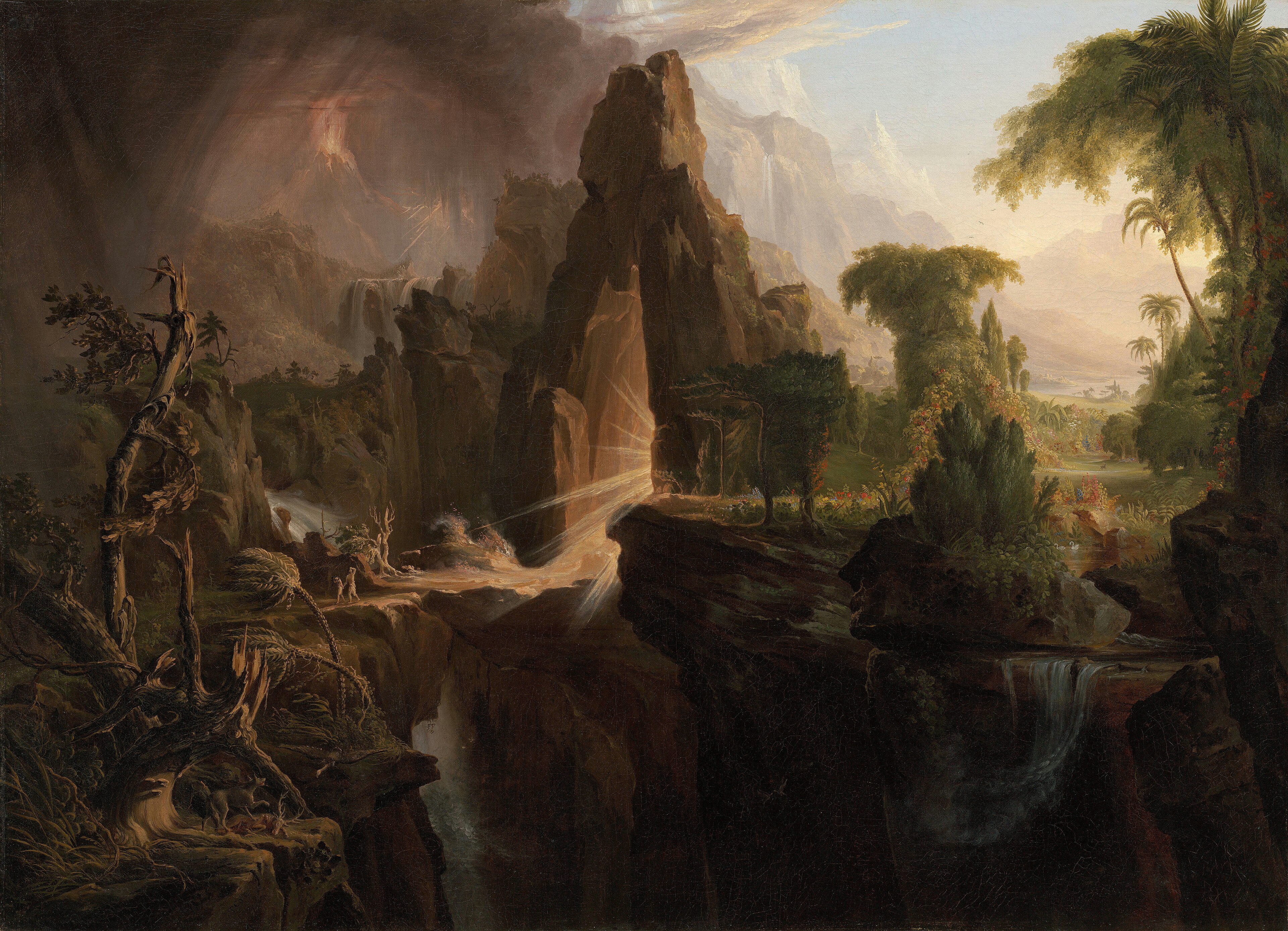
If you want to become God, you must eat the fruits from the Tree of the Knowledge and the Tree of Life. Adam and Eve wanted to be like God.
“Ye shall not surely die… Ye shall be as gods” (Genesis 3:4–5), the serpent said to Eve.
They ate first from the Tree of Knowledge. “The man has now become like one of us, knowing good and evil” (Genesis 3:22).
To prevent them from then eating the Tree of Life, God expelled them from Paradise; and for their attempt at becoming like God, they were punished.
Adam and Eve's pursuit of knowledge and immortality is our original sin. We have attained the Tree of Knowledge, but not the Tree of Life, which our banishment from Eden has placed beyond reach. We are half-gods — granted the infinite power of the intellect, but still finitely condemned to die like animals. We have learned to shape steel into modern metropolises, but our basic biology has yet to radically change. We have acquired godlike abilities without godlike bodies.
“The Tree of Life, immortality, is beyond our reach.” So, we compose cautionary tales against pursuing it, warning ourselves not to become godlike. We remind ourselves of Gilgamesh, Qin Shi Huang, and Ponce de León. Their fates all ended unhappily in disaster and death. Our original ambitions have become hubris. Our Slave Mentality only deepens.1
We have enshrined these lessons on the Hollywood screen and the published pages of the press. It is immoral to play God and Nature. The lesson in Jurassic Park instills that no man can harness the Tree of Life; it is reserved for the divine. “This is how you make dinosaurs? No— this is how you play God.”2 The scientists have repeated the original sin, and the plot is their bloody expulsion from the island.
Even with godlike magic in Harry Potter, death in the Wizarding World is still an inevitability. Tom Riddle was once a wizard seeking immortality. To live forever, he must commit a murder every time he wishes to split his soul into Horcruxes. They would protect his soul from death. But as suspected, the series ends with his unavoidable demise. J.K. Rowling's lesson is that the pursuit of immortality is morally self-corrupting.
Had Tom succeeded, Voldemort would have practically been a god, and the story's moral architecture would have collapsed. But it is also Rowling's need to preserve that architecture that exposes a weakness in her plot. Had Tom not been so crude and properly understood Zeno's paradox,3 he might well have achieved his goal of immortality.
The first murder is the true fall from grace. It is the original sin. But after his soul has already been torn, what is the moral significance of a second tear? Or the tenth? Or the hundredth? Rowling needs each murder to remain metaphysically grave. Voldemort's own logic should have pushed him toward the opposite conclusion. That once damnation has been accepted, the marginal cost of further damnation quickly asymptotes toward zero. To live forever requires full commitment to the part.
As well-intentioned as these stories may be, we foolishly accept these narratives as wisdom. Instead of building a better dinosaur cage and implementing more robust system redundancies, we question the nature of gene editing and de-extinction. Jurassic Park had world-class bioengineers but terrible systems engineers. Its supposed warning against playing God is, on closer inspection, a cautionary tale about bad park design and not hiring competent people. And perhaps, then, the real villain of Harry Potter is not Voldemort, but J.K. Rowling herself. As sole creator of her Wizarding World, she permits 11-year-olds to transmute matter, manipulate time, and brew luck, yet makes death inescapable unless through murder and self-imposed corruption.
Just like for Jurassic Park and Harry Potter, the premise beneath these stories must itself be questioned. These myths are not innocent warnings but at the foundations of our technological stagnation. They teach us that the search for immortality is not merely dangerous and difficult but corrupting and impossible.
We are now more capable than ever before. We must not take these stories to heart. We must look toward other stories — to the Towers of Babel and to the Towers of Bensalem.
The Tower of Babel
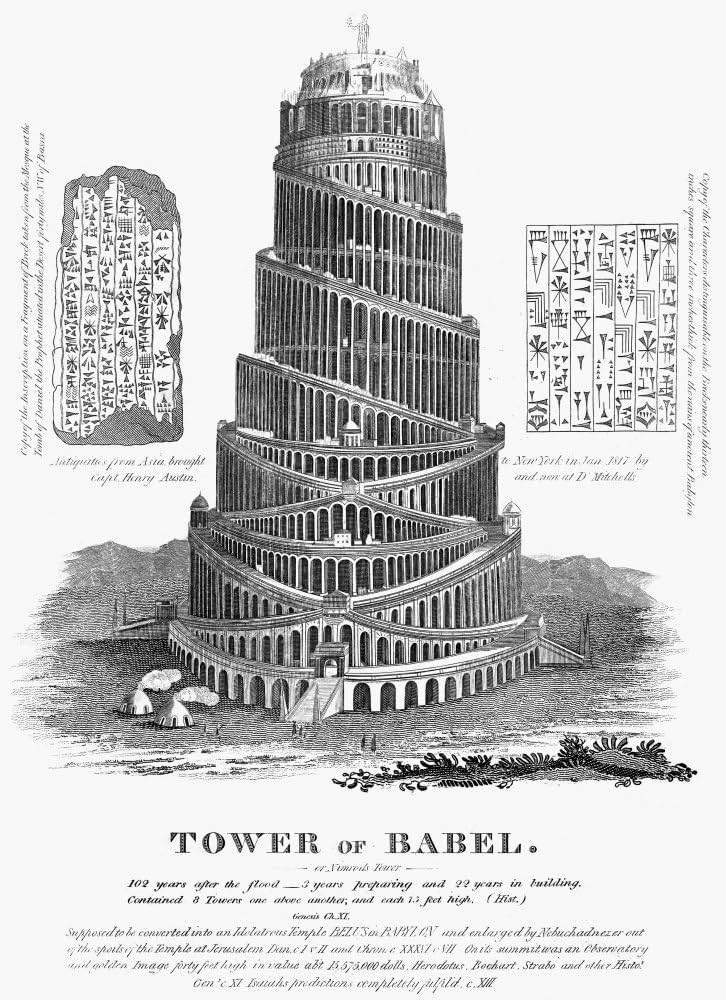
“And the whole earth was of one language, and of one speech… And they said, Go to, let us build us a city and a tower, whose top may reach unto heaven; and let us make us a name, lest we be scattered abroad upon the face of the whole earth. And the Lord came down to see the city and the tower, which the children of men builded. And the Lord said, Behold, the people is one, and they have all one language; and this they begin to do: and now nothing will be restrained from them, which they have imagined to do.” Genesis 11:1, 3–6
In the Tower of Babel, humanity is unified after the Great Flood and settles on the plain of Shinar. Their desire is to build “a city, and a tower, whose top may reach unto heaven” so they can “make us a name; lest we be scattered abroad upon the face of the whole earth.”
The manner in which God responds to this endeavor is striking. He stops their project by scattering them upon the face of the whole earth and confusing their language. The tower becomes abandoned, and the city is named Babel, after the Hebrew word balal, “to confuse.”
For what stated reason does God strike them down? There is no mention that they have sinned. There is no mention of them being arrogant or excessively proud. These are interpretations layered on afterward, but we must take the text for what it is. God strikes them down not for moral reasons, but for anti-competitive ones. It is a preemptive punishment against human capability: “Behold, the people is one, and they have all one language… now nothing will be restrained from them, which they have imagined to do.” It implies that one day, if left unchecked in our unity, we may overtake God.
But for now, only “with God” and God alone are “all things… possible” (Matt. 19:26).
The Towers of Bensalem
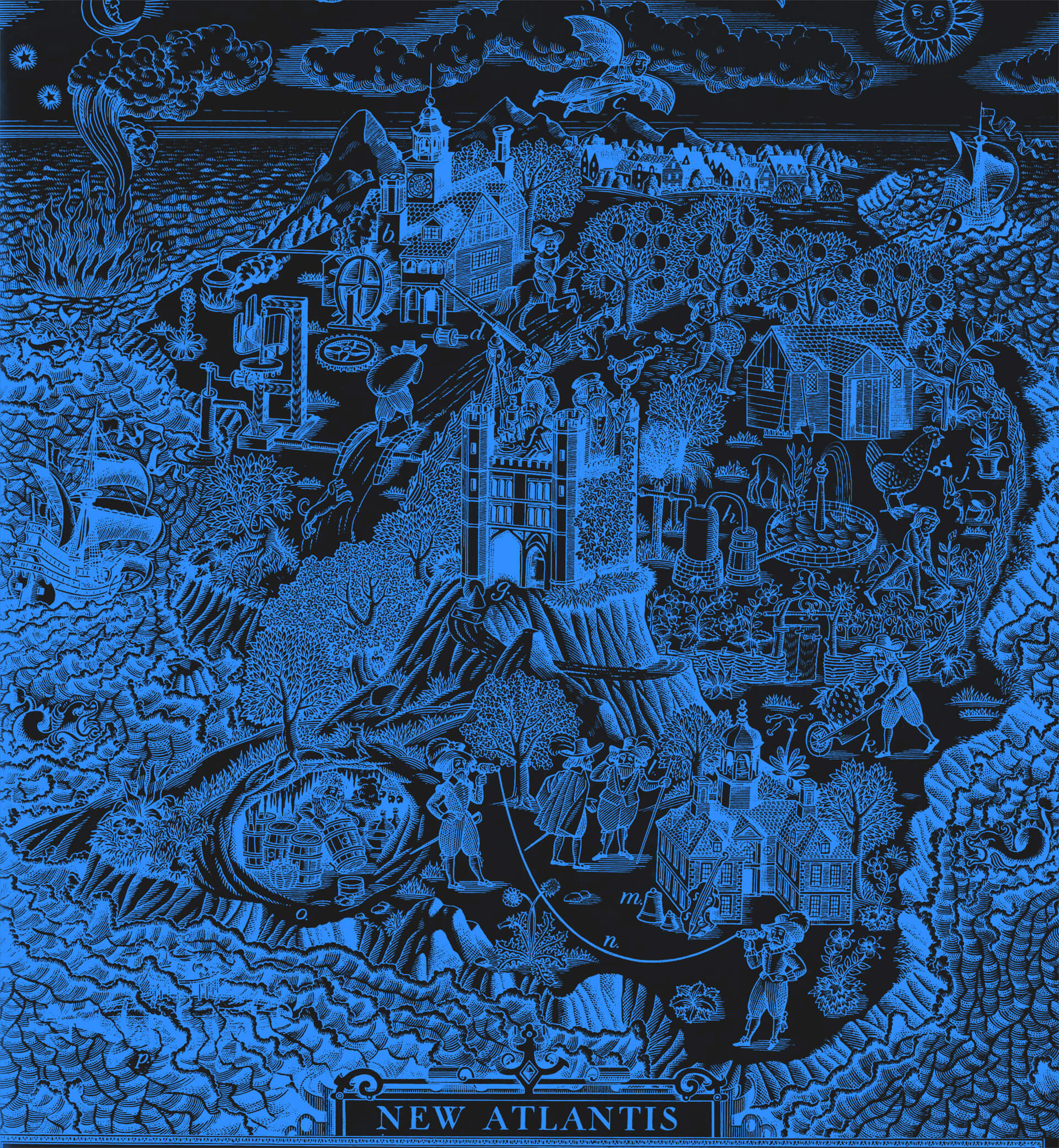
Four thousand years after Babel, a man named Francis Bacon embarked upon the creation of another tower. In his posthumous novella published in 1626, The New Atlantis, Bacon dreams of a secretive institution on the fictional island of Bensalem called Salomon's House. Salomon's House is a state-supported research institute that develops the technology that forms the center of Bensalem's society. Salomon's House has another name, “The College of the Six Days' Works,” in direct reference to God's six days of creation in Genesis.
The novella reveals the society of Bensalem from the perspective of lost European sailors blown off course and forced to take refuge there. Bensalem is as rich as it appears friendly, and the sailors are quickly enamored. They soon realize that Bensalem is intimately acquainted with every culture in the world, but they themselves are completely unknown to all else. The extent of their operations is revealed when a governor discloses that members of the College are sent on twelve-year spy expeditions around the world, to Europe and to Asia, to collect intelligence and to steal technology.
From the very first encounter with the Bensalemites, the sailors recognize that the technology on this island far exceeds anything they have known. It is not until the Father of the College reveals its staggering facilities that we grasp the true scale and advancement in which they operate.
The College contains and simulates all of nature. It is not simply a research facility. It is a model of creation itself — a world in miniature, rebuilt through human hands. Its caves descend “above three miles deep,” and its towers rise “three miles at least.” The institution reaches far below underground as it does to Heaven. Within it are gardens, lakes, fountains, baths, furnaces, animal enclosures, brewhouses, and medicine shops. There are “sound-houses,” “perspective-houses,” and “perfume-houses” devoted to the deception of all five senses; there are “engine-houses” that produce “all sorts of motion,” some flying and some underwater; there are “instruments of war… stronger and more violent” than the greatest in Europe; “mathematics-houses”; and even a “Water of Paradise” for “the prolongation of life.”
The College is Bacon's answer to Eden. Salomon's House is the institution built to recover both forbidden fruits: Knowledge through experimentation and Life through medicine. The people of Bensalem, like us, have not returned to Eden. Instead, they have created one themselves.
The Father states the College's purpose plainly: “The end of our foundation is the knowledge of causes, and secret motions of things; and the enlarging of the bounds of human empire, to the effecting of all things possible.”
Of the Two Towers
Both Bensalem and Babel exist under the same God. They both build at incredible scales, and they both chose to build towers. From the outside, they are the same act. From the inside, they build for very different reasons.
The Tower of Babel was built to reach toward the heights of heaven. It was built to establish permanence: a lasting unity, identity, and name. But the Tower intrudes upon heaven not merely as a physical structure, but as a claim about human possibility. If humans are ever truly unified, then “nothing will be restrained from them, which they have imagined to do” (Genesis 11:6).
“With God all things are possible,” declares Matthew. Babel reveals that the inverse is also true: with a unified man, all things may also become possible.
Among the things humans have always imagined is the conquest of death. Death is the final asymmetry between God and man. Death ensures that God will not be forgotten. A unified Babel would not need to steal the fruit from paradise because, with enough time, like the Bensalemites, they would learn to make their own Tree of Life.
This is why God strikes them down. The Tower itself is incidental. The act of collective construction is what matters. A unified and peaceful humanity is the precondition to anything it can imagine. Given enough cohesion, humanity may one day cease to need God. Babel's sin is not arrogance or pride, but self-sufficiency. In that condition, the threat to God is irrelevance — and so they are struck down.
Bensalem is much more unified than Babel because it does not require sameness. Babel's unity rests on one people, one language, and one God. It is powerful, but it is flawed. Once God confuses their speech, the whole project collapses. Bensalem, by contrast, contains different peoples, speaks different languages, and accepts different religions (though it remains primarily Christian). Their unity is not one people, one language, or one God. It is institutional. Bensalem has built a common tradition and a social contract; It has built systems of layered secrecy, hierarchy, and governance — all organized around the stated mission of the College. Their unity is not natural but engineered.
This makes Bensalem the true successor to Babel. Its towers rise far higher and descend much deeper into the earth — and its College has built not one tower, but many. Their scientific project explicitly aims at “the effecting of all things possible,” and within Salomon's House, they brew a “Water of Paradise” to prolong life. Bensalem does not merely threaten self-sufficiency; It has achieved it. Their towers do not need to reach toward Heaven the same way Babel's did. Instead, they have built their Heaven below, and God cannot strike them down.
“So miraculous are the inventions we later encounter that we wonder whether even Zeus could destroy the new Atlantis.”4 The old Atlantis was drowned by Zeus because of its avarice. This new Atlantis cannot be drowned because of its technology. Bensalem has crossed the threshold where divine punishment is no longer possible.
God cannot “confound their language, that they may not understand one another's speech” (Genesis 11:7), because Bensalem already contains the differences God introduced to Babel. Different languages, peoples, and religions are the mere starting conditions of Bensalem, not its vulnerability. Nor can God simply drown it as he drowned the old Atlantis. Bensalem's technology “wields near-omnipotence over the natural world.”4 The forces God once wielded against unified man are no longer enough.
But perhaps the deeper reason God cannot strike Bensalem is due to principle. Bensalem has done precisely what humanity was commanded to do: “Be fruitful and multiply and fill the earth and subdue it, and have dominion” (Genesis 1:28). Salomon's House is nothing but the essence of dominion over the Earth, the manifestation of this mandate. To punish Bensalem would be to punish obedience toward God. It would reveal that God never meant for the command to be fulfilled, only pursued endlessly. The asymmetry between God and man is to always remain intact.
God is in Zugzwang. If God strikes Bensalem and destroys it, he reveals Himself as morally inconsistent and unjust by punishing the people who are fulfilling his command to “be fruitful… fill the earth… and have dominion.” If God strikes Bensalem and fails, he reveals himself as not all-powerful, or at the very least, no longer uniquely so. And if God does nothing, Bensalem completes the project that Babel only began. The Water of Paradise is perfected; the Tree of Life is made attainable. Death becomes a choice, and God becomes irrelevant.
The only move left is to hide Bensalem from the world. Containment is God's last resort, so He can ensure that no one else builds what Bensalem has built. Bacon does this for him. He makes Salomon's House unknown to the world, invisible to Europe and Asia, and unknown to the sailors until one day they discover the island. But, “we might wonder whether anyone lands ashore on Bensalem except by the grace of Salomon's House and conclude that the winds that set the story in motion were not quite so random as they appeared.”4
Two Traditions
Babel and Bensalem represent two different traditions that yield two different societal outcomes. The tradition of Babel trusts in divine providence. The tradition of Bensalem trusts in human capability. The former ends in scattering and stagnation. The latter ends in abundance and dominion.
To follow Babel is to trust that the work of creation can only continue with God's permission. We build for God, at the mercy of God. We take responsibility out of our own hands and place it on God. God has the final say. God names our tower for us, and He chooses to name it Babel.
To follow Bensalem is to trust that the work of creation is humanity's to continue. We build under God to become God. We take responsibility into our own hands. We name our own towers, and we name them “The College of the Six Days' Works.” Bensalem is the continuation of Genesis, and perhaps the chapter of a second creation. There, humanity does not wait to return to Eden. We build our own.
We live in the tradition of Babel. Modern society treats projects of ambitious capability and scale as something to be feared and restrained rather than pursued. So we cut down the tall poppies before they can rise high enough to draw the attention of God.5 We have learned Babel's lesson too well. That to be seen reaching is to be struck. And so we strike ourselves first before God, so that Heaven may not scatter us — we scatter ourselves in advance.
We must reject this tradition. We must instead follow the tradition set by Bensalem and Salomon's House. To build for the knowledge of causes and the effecting of all things possible. To build the next Eden and the Tree of Life. To build the dominion of man for the sake of man.
Bensalem became like God. We should too.